A blurb on entrepreneurship

Everybody wants to be an entrepreneur. To be their own boss, set their own hours, and escape the rat race. 

A lot of times, people get excited about entrepreneurship because they want to work less. 

If that’s your goal, you probably shouldn’t become an entrepreneur. 

Building your own brand takes extreme ownership. Everything is on you. Every decision is yours, and with each choice you make, the future of your company could be at stake. That’s a lot of pressure.

There is no clocking in and clocking out. No one’s going to hold you accountable. You won’t get fired for playing hooky. But if you don’t put in the time, your business will fail. 

So, if you’re a self-starter who enjoys the process of building something, and you understand that in order to succeed, you have to create some kind of value, you probably have what it takes to build a brand. 

If you want to work less, entrepreneurship probably isn’t for you.

A blurb on truth and security

Once we’ve come to the knowledge of the truth, there is no rebuttal that can change anything. 

But, despite its objective nature, many will still rebut the truth. If one has not come to the knowledge of it, he will rebut it because he hasn’t yet recognized its indisputable nature. 

Therefore, for those of us who have already come to the truth, we must rejoice in simply that. The truth. We must not find security in others also recognizing it.

While it is a wonderful thing when someone sees the truth, that cannot be a source of validation for those who already know the truth. 

If we find validation and security in others coming to the truth, then we will ultimately collapse when others are unable to see. 

So, we must find security in the truth itself, and be simply glad when others are able to see it as well. 

The most important thing to know about me

I couldn’t figure out what to write today. 

I wrote a bit about entrepreneurship, but it sounded angry and that’s not what I was going for, so I’ll circle back when I have more time.

I considered sharing a bit about my Praxis journey. I thought about sharing some of the things going through my head as I prepare for the arrival of my baby. All good things, and probably all worth writing about, but they didn’t seem right for tonight.

I couldn’t make a decision. So, I asked myself: What’s the most important thing for someone to know about me?

Solid question. I gave it some thought, and came up with this:

Jesus loves me

That’s it. 

The most important thing about me is that the God who created all things came down from His throne, took on human flesh, lived a perfect life, paid the debt for my sin on the cross, rose from the dead, and offered me the free gift of eternal life and reconciliation into relationship with Him. All because He loves me.

Funny enough, the most important thing about me, isn’t really about me. It’s about Him. 

What’s even greater? I’m not the only one He did that for. He did it for you, too. 

If you know Him, then you already know that. If you know Him but you’re feeling distant, this is your reminder of what He did for you. 

If you don’t know Him, you can. Call out to him. He’s waiting for you to accept the offer. 

I’ll leave you with this:

I was dead in my sins. Deceived by the counterfeit comforts that this world offers. Ensnared in the traps of a very real enemy. 

Then Jesus set me free. 

The most important thing for someone to know about me? Jesus loves me. 

And He loves you too.

You might have to slow down to speed up

In a fast-paced and high-tech world, efficiency is king. Everyone wants what they want, and they want it fast. Regardless of whether or not that’s a good thing, it’s reality. 

But while everyone and everything is getting faster and faster, the real winners are the ones who pause and build meaningful connections with their customers. Those guys get it.

People ≠ numbers

Business should be balanced. It should be both relational & transactional. Today though, things can be almost completely transactional. No connection. No care. Just numbers. 

There’s a problem with that.

People are not numbers. They’re people. Real people with personalities, families, and most importantly, problems. Unique problems.

Why does this matter? Because business is all about solving problems.

But, to really understand a problem, you have to invest a bit into understanding the person it belongs to. And you can’t do that unless you slow down and build connections. 

A real-life example 

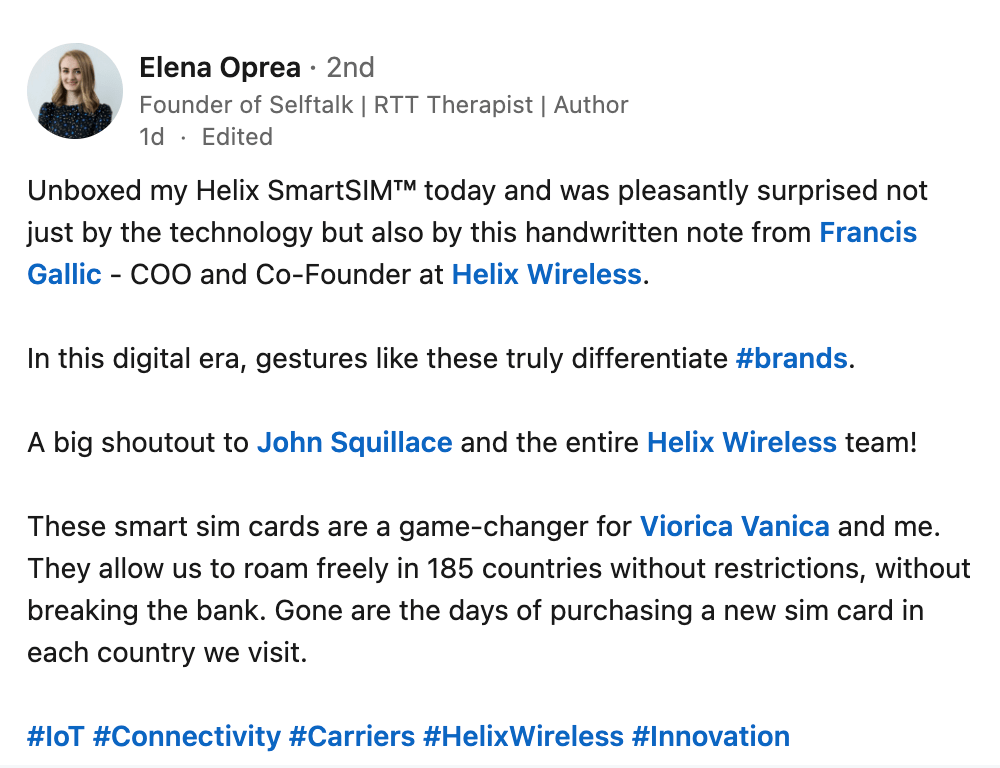
Check out this LinkedIn post from Elena Oprea, founder of SelfTalk.

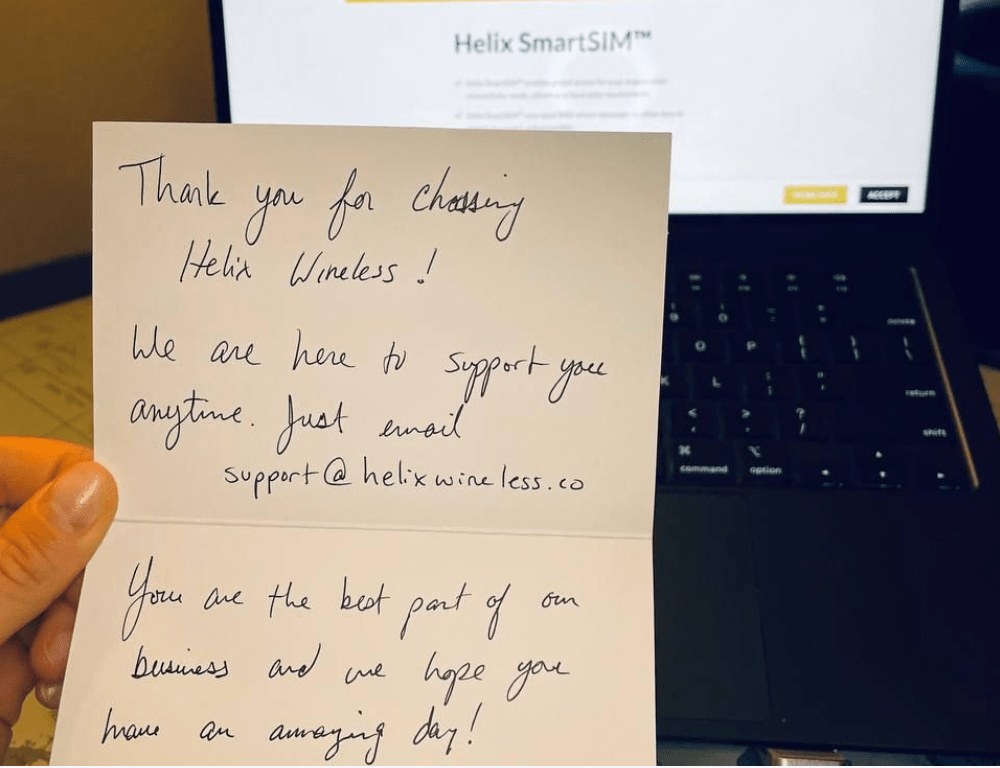
As you can see, she was “pleasantly surprised” to find a handwritten and personalized note from Helix Wireless’ COO.

He took probably just a few minutes to write that note, but with that, he invested in a relationship–an investment that will likely create a lifelong customer. 

Think of the domino effect that this will have: 

Elena posts this on LinkedIn–her industry-relevant network interacts with it–they see that Helix cares about its customers–they become customers.

Amazing. All of that from a simple thank-you note. Props to Helix Wireless for the absolutely premium customer care.

Understanding the value of people

I want you to notice what Francis wrote at the end of the note–

“You are the best part of our business.”

That is profound. That mindset is priceless. It’s fuel.

If you can get up every day, and build something that, at its core, helps people, then you’ll always have a reason to love what you do, no matter what it is. 

If you realize how valuable the people you serve actually are, you’ll always have an edge.

Business doesn’t have to be go-go-go all the time. In fact, it shouldn’t be. It should be balanced. It might be the go-go-go that brings a customer in, but it’s the slowdown that keeps them on board.

So work hard, be efficient, and build something great-those are all good things.

Just don’t forget to stop and write handwritten notes.

A short piece on being offended

Taking offense is pointless. 

Funny enough, there are some who might be offended by that statement. 

It’s very natural to feel offended, but that doesn’t mean it’s helpful. 

Being offended falls under the umbrella of resentment. I’ve heard it said that resentment is “like drinking poison and waiting for the other person to die.” Taking offense isn’t too far off from this.

I believe it’s a two-pronged issue.

On one hand, taking offense doesn’t do anything to the person or thing that caused it. It only upsets the one who was bothered. It’s not often that someone offends someone and is then changed by the offended party’s displeasure with them. 

On the other hand, offense is often taken by those who aren’t entitled to it. If a blogger wrote something that offended you, you wouldn’t really have any right to be upset about it. You don’t have to read their posts. You choose to. You can simply not read their blog posts. 

Is it not a tremendous waste of time to get upset about something you didn’t have to?

It only hurts your own well-being. Don’t give it any free space in your mind. 

There is, perhaps, a need to address the things that you find yourself offended by. If you just can’t get past it, then I would say it’s time to figure out how to, but this can and should be done without remaining “offended.” 

I might explore this idea again at a later date, but since it’s 9 p.m. and I haven’t posted today’s blog yet, I’ll leave it at this.

I hope that doesn’t offend you 😉.

Don’t do anything “just because…”

Stop making decisions based on what you think others expect you to do. 

Don’t go to college just because that’s what everyone else does after high school and “it’s your only option.” 

Don’t go into finance just because that’s what your dad does and it “just makes the most sense.”

Don’t buy the fancy car that doesn’t fit in your budget just because your friends have nice rides and you “want to fit in.”

Don’t do anything “just because…’

Have real reasons for the things that you do. 

Break free

Listen, if you actually want to do any of the things I mentioned above, absolutely go for it. I won’t stop you. You’ll find that I’m all for people making their own decisions.

I just want you to know you have options. You don’t have to live your life on autopilot. You can break free from the mold.

Why go to college?

Let’s focus on the whole college thing. 

For basically your entire life, you’re taught that to be successful, you have to go to college. 

Here’s the problem with that: it insists that success is encapsulated by this: graduate high school, go to college, get a job in your major, and serve your time there until you can retire.

Now, this is only my opinion, but there’s a lot that’s wrong here.

First of all, you can go get a “real” job and be great at it without a college degree. I don’t even need to pull a source to prove this. I’ve done it myself, and so have hundreds of others who went through Praxis. On top of that, there’s plenty of people who have carved their path almost entirely by their own doing. It’s clearly an achievable goal.

So already, we’ve eliminated the need for college if your goal is getting a job.

So, why go?

For the social life.

This usually refers to the party lifestyle that the college experience typically offers. That can be done without college. I personally believe it’s one of the worst ways for a person to spend their time, but nonetheless, it can be done without enrolling at a college. 

You could move to a college town, you could go to house parties, you could go to bars/clubs…you get the point.

If you can get a job without a degree and you can get the social experience without college, why go? 

To be honest, unless your desired vocation legally requires that you hold a degree to practice it, I can’t see any reason why someone would go to college. Yet, so many high school graduates still elect to pursue a degree. 

Oh, and I haven’t even mentioned the absurd amount of debt that you’ll likely collect. That’s not something to overlook.

Make the decision for yourself. Take a look at all of your options. Don’t let the pressures of guidance counselors and academic institutions push you into their groupthink machines without at least seeing what else is out there.

But look, If you’re definition of success is the one we outlined at the beginning of this section, then go for it. As long as that’s what you really want to do.

Changing the perspective on success

We haven’t even considered the fact that success might actually mean something completely different for you than what the “system” offers you. 

What if you wanted to travel? What if you wanted to live by the sea and spend your days on the water? What if you wanted to do something different than the mob? Wouldn’t your definition of success be different from what we presented earlier? 

If you got a job waiting tables at a little bistro in a shore town, made enough to have a place to stay, and all your necessities (food, water, bathroom, clothes, etc.), you could enjoy your life by the sea. If that life was your goal, you’d be a success.

But if you graduated high school, went to college, got a degree, and by chance landed a desk job, then by your standards you haven’t achieved success. 

What a shame.

Because of the pressures of academia and culture, you give up your dreams for the sake of fitting in. 

You seriously don’t have to do that.

There’s almost always a choice

The ball is in your court. 

When it comes to how you spend your time, build your career, and how you define success, it’s all up to you. Embrace that.

Make the choices that best suit your goals.

Signing off

When it comes down to it, the choices you make probably have a very low chance of impacting me. So, I’m a pretty neutral party when it comes to your life and decisions. 

I really just want you to know that you have choices. The manufactured path is not mandatory, but most people won’t tell you that. So, I’m telling you.

I will leave you with this:

You have options. Find out what they are and figure out which one is the best way for you to reach success. Don’t conform to what everyone else is doing. 

It’s up to you.

Resist the fear of failure, and it will flee from You

“‘You miss 100% of the shots you don’t take. -Wayne Gretzky’ -Michael Scott”

To achieve anything worthwhile, we must abandon the fear of failure.

Yet, it seems to be the voice that we listen to the most. 

If you’re thinking of building your own business, applying for that job that’s a bit out of reach, or even challenging yourself to blog daily for 30 days, it’s likely that you’ll run into the fear of failure. It sounds like this:

You’re not capable. What if you fail? What will people think of you? 

This is when you have to resist. 

You will tempted to entertain the thoughts. To comb through them and to dissect them. Don’t. With everything in you, turn away. 

Fear comes to stop you. To tear you down. To thwart your mission. 

Don’t let it. 

It’s that simple. But it’s not easy.

Instead of trying to make sense of a lie, you must recognize its ugly nature and turn to what’s true. Commit to the next step of building your business, go for the job that’s out of reach, write your blog posts one day at a time. 

Behind the fear of failure is the fear of man. You are worried about what people will think. 

What will my family think of me if I take this risk? What does rejection say about me? What will my friends think if I share this thought? 

There is no reason to care what others will think of you for trying to do something great. If you never take the chance, then you’ll stay where you are right now. If you take the chance and fail, you’ll still be in the same spot, but you’ll have all the knowledge you’ve gained from the experience. You’ve got nothing to lose by trying. 

Ignore the doubting voices.

Turn from the lies being planted in your mind. The ones that come to steal from you, kill you, and destroy you. 

Resist the fear of failure, and it will flee from you.

DevOps Compliance – Why You Need to Automate (2023)

Security is a crucial component in the development of any great software solution. It’s all about trust. If the customer doesn’t trust that their data is safe, then they won’t use the product. Compliance organizations and standards ensure that developers meet high standards of safety and security, but if any coding errors are missed in the development process then you have to retrace your steps and try to fix the problem. This creates significant delays in the development and release processes. A proper DevOps automation platform erases this slowdown. 

What is Compliance?

ADP defines compliance in business as, “ adherence to all local, state and federal jurisdictions that govern your operations.”

For context, the Health Insurance Portability and Accountability Act (HIPAA) and the General Data Protection Regulation (GDPR) are two examples of compliance standards you’ve probably heard of before. 

In software development, compliance is making sure that all code meets the standards set by governing organizations aiming to only allow secure and legal products to be on the market.

The Challenge

Compliance often prolongs release times. 

If the standards aren’t met at every step of the development process, teams will have to go back into their code, diagnose the error, and implement the solution.

This eats up a lot of hours that could instead be used for something like improving the user experience, running marketing campaigns, or hosting demos for potential clients.

How can this be avoided?

The Solution

Lots of teams have tackled this challenge by implementing Compliance Automation.

By automating compliance checks throughout the entire development process, errors are caught earlier. This way, the code can be corrected as it’s written, instead of after its been implemented for weeks or months. 

Simply put, problems are flagged by your automated system, so your team goes in and makes the correction, and the product can hit the shelves earlier because the error was fixed almost immediately. 

How Can DuploCloud Solve This Problem? 

DuploCloud is a “DevOps automation platform that accelerates time-to-market by translating high-level specifications into low-level details for fully managed cloud configurations.”

With out-of-the-box compliance controls for SOC 2, PCI-DSS, HIPAA, HITRUST, NIST, GDPR, and others, you can completely automate your DevOps Compliance processes, saving time and boosting efficiency.

Check out their demo page if you’re interested in learning how their solutions are succeeding in cloud infrastructure automation.

While meeting compliance standards can be a pain-in-the-neck, they do ensure that software is ready to be out in the real world and I definitely don’t see them disappearing anytime soon. So, you should be integrating compliance into your processes early on, so you can boost efficiency and bring your products to market faster.

The Bravado of Passion

We often operate in an authoritative mindset on topics that we have no business speaking on with such confidence. 

A prime example? Self-appointed sports commentators.

I have read a regrettable number of tweets and Instagram comments that shared strong, and often uninformed opinions on sports organizations, players, coaches, etc.

These comments are usually fiery, often insulting, and spewed from thrones of self-declared credibility. 

Most of these “analysts” have not spoken to anyone in the organization, yet somehow they know everything the GM is thinking. They haven’t interviewed players or studied their film, yet they know all there is to know about what’s wrong with a player’s mechanics. If a user like @joemama69 thinks that “player xyz” sucks and his career is over, then I guess someone better tell “xyz” to retire, right?

This, in my opinion, is a silly and low-importance problem. However, it points to a much broader concept: The Bravado of Passion. 

The Bravado of Passion is the false confidence that is built on the foundation of strong feelings. 

(Full disclosure: I just coined this term and I’m not even entirely sure it makes sense, but I like the way it sounds, so it’s staying)

Strong feelings do not give us the right to be an authority on a topic. Strong feelings may motivate us to become an authority on a topic, but they are not what qualifies us. 

So then, what makes a person an authority on a subject?

I will explore that in a later post 😁.